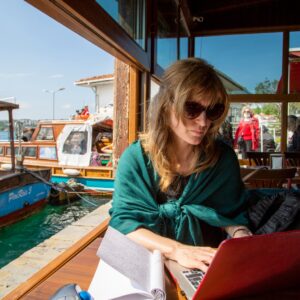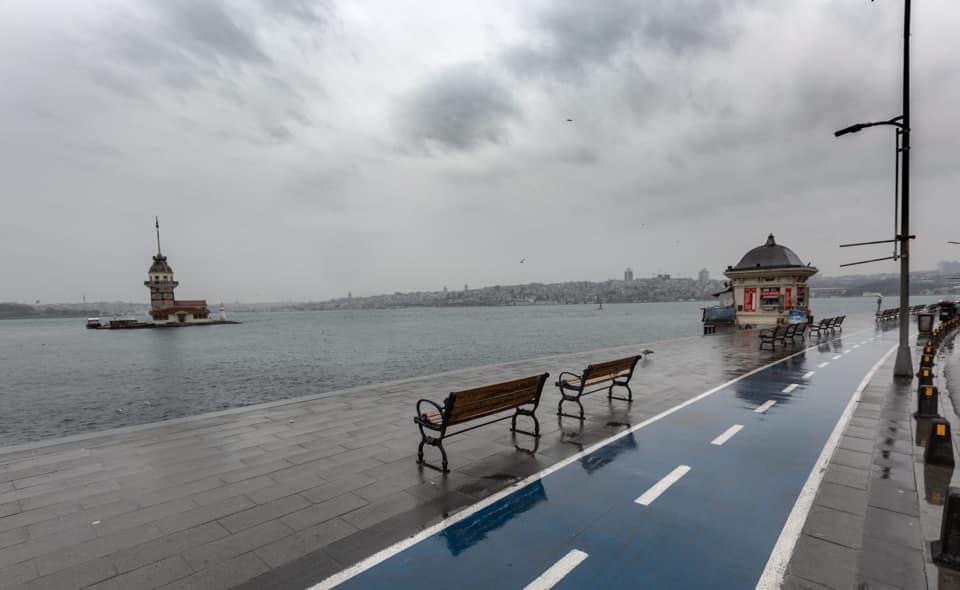
Today is my seven-year anniversary of living in Istanbul.
Seven years, as the saying goes, is when things begin to fall apart. It often marks the end of the honeymoon period in relationships, jobs, homes, and even love affairs with cities.
So naturally, I started thinking about how to celebrate.
The first idea that came to mind was to grab a bottle of rakı (Turkish anise-flavored liquor) and take a ferry ride down the Bosporus, one of the many reasons this city is difficult to leave.
I thought, “If the crew protests, I’ll tell them, ‘Abi, come on. It’s my seven-year anniversary.’”
And if there’s anything I’ve learned from living in Istanbul, it’s that rules were made to be broken. Including, possibly, the unspoken rule that you eventually leave.
Lesson No. 1: Rules were made to be broken.
Crosswalk signals are merely a suggestion. If you have a collective mass, i.e. two to three determined pedestrians, you may cross the street at any junction, whether or not the walk symbol is illuminated. Motorists are resigned to this unwritten code of conduct.
I resisted this practice at first. Then, I realized I was the only one going nowhere.
This principle also applies to taxis. Taxi drivers in Istanbul don’t take you where you want to go; they take you where they want to go.
I once tried to catch a taxi to a doctor’s appointment during rush hour. Five drivers refused because they didn’t want to deal with the traffic on the route. So, I adjusted my expectations and eventually, my sense of urgency.
Lesson No. 2: Learn Turkish earlier.
When I moved to Istanbul, I didn’t anticipate that I would stay for seven years. As a result, my interest in Turkish was lukewarm in the beginning. For the first few years, I survived on about six phrases, facial expressions, and charades. Seven years later, I have expanded my repertoire to about 12 phrases.
What’s particularly humbling is that in English, I’m a stickler for grammar. I will even correct typos in agendas when the meeting is live. In Turkish, I’m just grateful if I’m understood, preferably on the first try.
Lesson No. 3: Give your Istanbul cat a Turkish name.
This is another regret. When I adopted my Turkish cats, I gave them English names. After learning more Turkish, I realized there are so many adorable Turkish options such as Patı (paw), Miskin (lazy), and Bıcırık (little one).
I also would have taught my cats basic Turkish. They are, after all, citizens of this nation. I am the foreigner. And yet they are the ones who don’t respond when someone offers them food with the Turkish cat call, “pspsps.”
Lesson No. 4: Call the usta.
At some point while living in Istanbul, you will need help fixing something in your home. This is when you call the usta, which translates to “expert.” This doesn’t necessarily mean they are experts. Ustalar aren’t required to be licensed, and while some are masters of their craft, others are masters solely of bravado.
You will not always know which one you have invited into your home until the work has commenced, which brings me to the next lesson.
Lesson No. 5: Connections are everything.
After a few experiences with ustalar, you will learn that finding a good one has a lot to do with knowing the right person.
In Istanbul, recommendations are a way of showing you care about your friends and won’t leave them to the wolves.
If you need a reliable electrician, ask a friend. If you had a good experience with a doctor, tell a friend.
This is both comforting and disconcerting. It’s comforting, because friends help solve most problems you encounter, and alarming when you realize that if you don’t have the right network, certain doors just won’t open.
Lesson No. 6: Your sense of safety changes.
Before I moved to Istanbul, I never thought of Türkiye as dangerous. What has changed is not my perception of Türkiye; it’s how I feel when I go back to the U.S.
After years of walking through Istanbul late at night, along the Bosporus, and through crowded streets, I’ve developed a sense of personal safety that I didn’t have before.
Like many cities, Istanbul has risks; it has streets where you shouldn’t walk at night. But there is an everyday public life here with people outside, streets in motion, and a constant presence that makes me feel at ease.
And when I go home, I lose that feeling. Instead, I find myself more on edge, even when walking alone during the day.
Part of it may stem from distance. When you live somewhere, your understanding of it comes from what you see every day. When you’re away, you rely on what you read in the headlines.
It’s a strange reversal and one that feels ironic when people in the U.S. ask me, “Is it safe there?”
Lesson No. 7: Some things cannot be replaced.
Istanbul has many things: history, beauty, chaos, cats.
It does not have good tacos.
Over the years, I’ve developed a coping mechanism. Whenever I visit the U.S., I return with a suitcase full of green chilis, corn tortillas, pinto beans, and Tapatío hot sauce, anything that might get me a little closer to the real thing.
And then there are the things that don’t fit in your luggage, like the people you love.
Seven years is supposed to be a turning point. Maybe it is. Maybe it’s when you finally see what works, what doesn’t, what you’ve adapted to, and what you never will.
I don’t know if I’ll still be here in seven months or seven years, or if life will pull me in another direction.
But I do know this: Istanbul has taught me how to live with uncertainty, how to adapt with a sense of humor, and how to let go of the belief that things should always make sense.
And maybe that’s why the question of whether to stay or leave doesn’t feel as urgent as it once did. Because right now, I’m still here, catching a breeze from the Bosporus, loving on the street cats, speaking in broken Turkish, and trusting that this is where I’m meant to be.